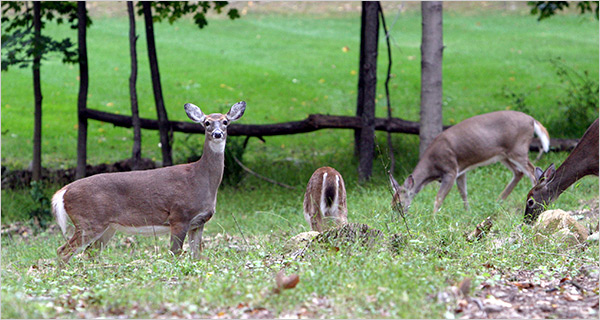
The $10,000 question: “Can humans get Chronic Wasting Disase (CWD) from eating infected venison?” The fact is that meat from deer contaminated with CWD may be more dangerous than originally thought, according to ongoing research.
Stefanie Czub, of the Canadian Food Inspection Agency (CFIA), and the University of Calgary, has documented CWD infections in monkeys. During the study, which began in 2009, 18 macaques were exposed to CWD in a variety of ways: by injecting into the brain, through contact with skin, oral administration and intravenously.
CWD Contracted by Monkeys
So far, results are available from 5 animals, according to a release from the CFIA. At this point, 2 animals that were exposed to CWD by direct introduction into the brain, one that was administered infected brain material orally and two that were fed infected meat all have become infected with CWD.
“The ‘supposed’ resistance of macaques was about the only prop remaining in the complacency wall (macaques’ genetics are closer to ours than squirrel monkeys, which also can contract CWD), but this is just the tip of the iceberg. The implications to markets are enormous, and governments here may have finally begun to take notice,” said Darrel Rowledge, director of the Alliance for Public Wildlife in an interview.“
Consumption of CWD-Infected Venision
CWD is a sister disease to bovine spongiform encephalopathy, or BSE — the infamous “mad cow disease” that killed 229 people in the United Kingdom — and is an incurable, always fatal degeneration of the brain, according to an analysis published by the Alliance for Public Wildlife. It was first documented in captive mule deer in the late 1960s.
Estimates show 7,000 to 15,000 CWD-infected animals are being consumed by humans every year, according to the analysis, and these sort of prior diseases are known for jumping between species barriers.
“Results of CWD laboratory challenges of non-human primates are mixed,” the analysis said. “CWD transferred readily to squirrel monkeys orally (92 percent), but macaques, which are genetically closer to humans than squirrel monkeys, have demonstrated significant resistance, even to direct intracerebral injection. It should be noted, however, that recently macaques were shown to be susceptible to scrapie, but only after an extended, silent incubation of ten years.”
CWD and Hunters
The news about CWD in primates has many in the hunting community concerned. Tim Donges, president of the Quality Deer Management Association’s Bluestem branch, recently spoke out about urgency by decision-makers after hearing the recent reports.
“I was in the meeting in Texas with Darrel Rowledge and he is very concerned about public safety,” Donges said. “Once the first human is thought to have contracted CWD, we could see fallout in the ag market because of food safety concerns. This is becoming a very serious situation. I do not see a way to stop the spread. The U.S. government has bought deer farms contaminated by CWD and are considered contaminated super sites.”
Donges said the government has tried several means of containing the disease, including radiation, burning the soil in furnaces and formaldehyde, with no success.
Spread of CWD
“CWD prion can be moved by wind blowing dust or rain water moving contaminated soil,” Donges stated. “Scavengers such as vultures, crows, coyotes, mice, opossum, etc., can move the prions. I have seen a vulture in Kansas that was tagged by the U.S. Fish and Wildlife Service, it migrated from Venezuela to Marion County, Kan. Deer hunters could move contaminated carcasses from a CWD area such as northwest Kansas to another state or another part of Kansas and spread the disease. Captive deer farmers (could be) moving live infected deer. Prions can come up through plants and other animals or humans could digest it.”
He said he has suggested to the National Deer Alliance that the organization go to Washington, D.C., and lobby for implementation of the “Deer Hunting and Conservation Act,” which would pull in resources from the USFWS, the U.S. Department of Agriculture and the Department of the Interior to combat the disease.
Twenty-four states now have reported CWD. The population model suggests that some day we will no longer hunt deer species in North America. The best thing hunters can do at this point is to start having their deer tested for CWD prior to consumption in order to protect themselves until we can learn more. We should not be moving carcasses around to other parts of the state or country.